Commercial Interior Design for Cafés & Restaurants: How To Create Spaces That Look Beautiful, Work Hard and Build a Brand
Commercial Interior Design for Cafés & Restaurants | Genesis Interior Stylists
Commercial Interior Design Is About More Than Making a Space Look Good
When people think about café or restaurant interior design, they often think first about how the space will look. The colours. The furniture. The lighting. The Instagram moments.
Of course, all of that matters.
But for a commercial hospitality space, good design has to do far more than simply look attractive. It needs to support the business.
A successful café or restaurant interior should help shape the customer experience, strengthen the brand identity, improve flow, encourage repeat visits and create a space people remember.
At Genesis Interior Stylists, this is how we approach commercial interior design. We don’t just ask, “What will look nice?” We ask:
How should people feel when they walk in?
How will customers move through the space?
What makes the brand memorable?
Where are the strongest visual opportunities?
How can the design support long-term commercial success?
This article gives a behind-the-scenes look at how we approach café and restaurant interior design projects, using a recent proposal for a new tea house concept as an example of our thinking.
Starting With the Brand, Not Just the Interior
Before we look at furniture, flooring or colour palettes, we start with the identity of the business.
For hospitality interiors, the brand and the space are closely connected. A café or restaurant is not just a room people sit in. It is an experience.
The interior should help communicate:
- The personality of the business
- The type of customer it wants to attract
- The atmosphere people should expect
- The level of quality and care behind the brand
For a recent café concept, the aim was to create a space that felt warm, elevated, atmospheric, modern and design-led, while still holding subtle South Asian influence.
That balance is important.
Rather than creating something overly themed or traditional, the goal was to develop a modern hospitality interior that felt culturally rooted, but still refined, commercial and appealing to a broad audience.
This is a common challenge in restaurant and café design. The space needs character, but it also needs longevity.
Understanding the Customer Experience
Good commercial interior design starts by thinking about the customer journey.
From the moment someone walks through the door, the space begins communicating with them.
They are instantly making decisions:
Does this feel welcoming?
Does this feel premium?
Do I want to sit here?
Would I come back?
Would I take photos and share this with friends?
For cafés and restaurants, this matters enormously.
A strong hospitality space should support:
- Quick visits
- Relaxed dining or tea experiences
- Social gatherings
- Casual meetings
- Study or laptop sessions
- Evening desserts or snacks
- Repeat visits
The design has to be flexible enough to support different uses without feeling confused.
That means the layout, lighting, seating, materials and styling all need to work together.
Layout and Flow: One of the Most Important Early Decisions
One of the biggest commercial design decisions is layout.
In a café or restaurant, poor layout can damage the customer experience before the design has even had chance to shine.
We look carefully at:
- Where the counter should sit
- How customers enter and queue
- How staff move behind the scenes
- How much breathing space is needed
- How the seating should be arranged
- Where visual focal points should be created
For the tea house concept, one of the earliest layout discussions focused on the till and counter position.
This was not just a practical decision. It was a brand decision.
The counter area often becomes one of the strongest visual moments in a café. It can establish the first impression, create a sense of arrival and give customers an immediate understanding of the business.
A well-designed counter can support:
- Brand identity
- Customer flow
- Product display
- Visual hierarchy
- Social media appeal
This is why we always treat layout planning as a major part of the design process, not an afterthought.
Creating a Memorable First Impression
In hospitality design, first impressions matter.
When someone enters a café or restaurant, the first few seconds shape their emotional response to the space.
A strong entrance or counter area can instantly tell customers:
This place is considered.
This place has quality.
This place feels different.
This place is worth remembering.
For this type of project, we look for opportunities to create defining design moments using:
- Feature lighting
- Textured wall finishes
- Curved forms
- Warm materials
- Bespoke signage
- Display shelving
- Sculptural counter detailing
- Atmospheric lighting
These are the details that help a café become more than just another place to buy a drink.
They help create an experience.
Food and Beverage Direction Influences the Design
A café or restaurant’s menu should influence the interior.
For the tea house concept, the food and beverage direction included premium tea culture, tandoori chai, clay pot presentation, pakoras, toasties, cakes, desserts and display counter pastries.
That matters from a design perspective.
Why?
Because the way products are prepared, displayed and served creates design opportunities.
Premium tea preparation can become theatre.
Clay pot presentation can create storytelling.
Display cakes and pastries can become part of the visual identity.
A strong counter can encourage customers to browse, stay longer and spend more.
In hospitality interiors, food and design should support each other.
The most successful spaces feel joined up. The interior, menu, service style and customer experience all work together.
Designing for Social Media Without Making It Gimmicky
Social media now plays a huge role in hospitality businesses.
People don’t just visit cafés and restaurants for food and drink. They visit for atmosphere, experience and shareable moments.
That doesn’t mean every wall needs neon signs or overdone photo corners.
The best social-media-friendly interiors feel natural.
They are memorable because the space has:
- Good lighting
- Strong materials
- Beautiful seating
- Interesting textures
- A clear identity
- Carefully designed focal points
For commercial clients, we think about where customers are likely to take photos and how the design can support that without feeling forced.
A café should feel good in real life first.
If it photographs beautifully too, that is the bonus.
Material Choices: Beauty, Durability and Commercial Practicality
Materials in commercial interiors need to do a difficult job.
They have to look beautiful, but they also need to withstand heavy use.
For café and restaurant projects, we consider:
- Durability
- Cleaning and maintenance
- Cost effectiveness
- Customer comfort
- Texture and atmosphere
- Longevity
- Brand alignment
For the tea house proposal, flooring was a key discussion. Luxury vinyl tile was considered as a strong option because it can provide warmth, a natural wood appearance, commercial practicality and easier maintenance.
This is exactly the type of balance commercial interior design requires.
A material might look beautiful, but if it is difficult to maintain, too delicate, too expensive or unsuitable for daily customer traffic, it may not be right for the project.
Good design has to survive real use.
Wall Finishes and Atmosphere
Wall finishes are another important part of hospitality design.
In many commercial spaces, plain walls can quickly make the interior feel unfinished or underwhelming. At the same time, going too decorative can date quickly or feel overly themed.
For this type of café concept, we would explore layered wall treatments such as:
- Lime wash effects
- Textured wall finishes
- Decorative panelling
- Architectural detailing
- Feature walls
- Integrated lighting
- Sculptural surfaces
The purpose is not to decorate for the sake of it.
The purpose is to create atmosphere.
Texture helps a hospitality space feel more immersive, more premium and more memorable. It also gives the customer something to emotionally connect with.
The goal is always to make the space feel intentionally designed rather than simply fitted out.
Bathrooms Matter More Than People Think
Bathrooms are often overlooked in café and restaurant projects, but they have a major impact on customer perception.
A poorly designed bathroom can quietly damage the impression of the whole business.
A well-designed bathroom, even a small one, can become a memorable detail.
For hospitality interiors, bathrooms should feel:
- Clean
- Practical
- Cohesive with the main space
- Well lit
- Considered
- On-brand
In a smaller café, the customer toilet may be compact, but that does not mean it should feel like an afterthought.
Designing the bathroom alongside the main café space helps ensure:
- Material continuity
- Better lighting language
- A stronger customer experience
- A more complete brand environment
These are the details customers remember.
FF&E: Furniture, Fixtures and Equipment
FF&E stands for furniture, fixtures and equipment, and it plays a huge role in commercial interiors.
For cafés and restaurants, FF&E may include:
- Tables
- Chairs
- Banquette seating
- Decorative lighting
- Counter stools
- Display shelving
- Mirrors
- Wall décor
- Styling accessories
- Decorative objects
- Soft furnishings
- Commercial layout elements
Choosing FF&E is not just about filling a space.
It is about choosing pieces that support comfort, capacity, atmosphere and budget.
For example, a chair might look beautiful but be uncomfortable for longer visits. A table might look perfect but not work well for service flow. A decorative light might create atmosphere but not provide enough practical illumination.
This is where commercial awareness is essential.
Every choice has to support both the design and the business.
Budget and Procurement Strategy
Budget is one of the most important parts of any commercial interior design project.
At early concept stage, it is often too soon to provide a fully itemised FF&E breakdown. That is because too many key decisions still need to be confirmed, including:
- Final layouts
- Seating capacity
- Finish levels
- Product quality expectations
- Client or investor feedback
- Specification requirements
Providing detailed costs too early can create problems.
It can lead to unrealistic expectations, incorrect assumptions, underpricing, overpricing or poor procurement decisions.
Instead, we help clients establish a realistic early-stage investment range, then refine costs once the design direction, layout and specification level are clearer.
This protects the client and the project.
It means decisions are made properly rather than rushed.
Why Commercial Interior Design Needs a Strategic Approach
A commercial interior is an investment.
It needs to look good, but it also needs to support revenue, reputation and customer retention.
That is why we consider:
- Commercial awareness
- Customer psychology
- Brand identity
- Layout efficiency
- Supplier relationships
- Budget management
- Long-term value
- Operational practicality
Our role is not just to make spaces look beautiful.
Our role is to help businesses:
- Launch successfully
- Stand out visually
- Improve customer experience
- Encourage repeat visits
- Avoid expensive design mistakes
- Spend budgets strategically
- Build a memorable brand environment
This is especially important for cafés and restaurants, where customers have more choice than ever.
The interior can be a powerful reason people choose you.
Inspiration Is Useful, But Originality Matters
Many commercial projects begin with inspiration references.
That is helpful.
But the aim should never be to copy another venue.
For this café project, an early inspiration reference was discussed, but our recommendation was clear: the business should push beyond local references to create something distinctive and original.
A strong hospitality brand should not feel like “another café.”
It should feel recognisable in its own right.
The opportunity is to create:
- A destination
- A memorable visual identity
- A hospitality-led brand environment
- A culturally inspired but commercially modern café concept
The strongest hospitality businesses today understand one thing clearly:
People visit cafés for experiences, not just drinks.
The design has to support that.
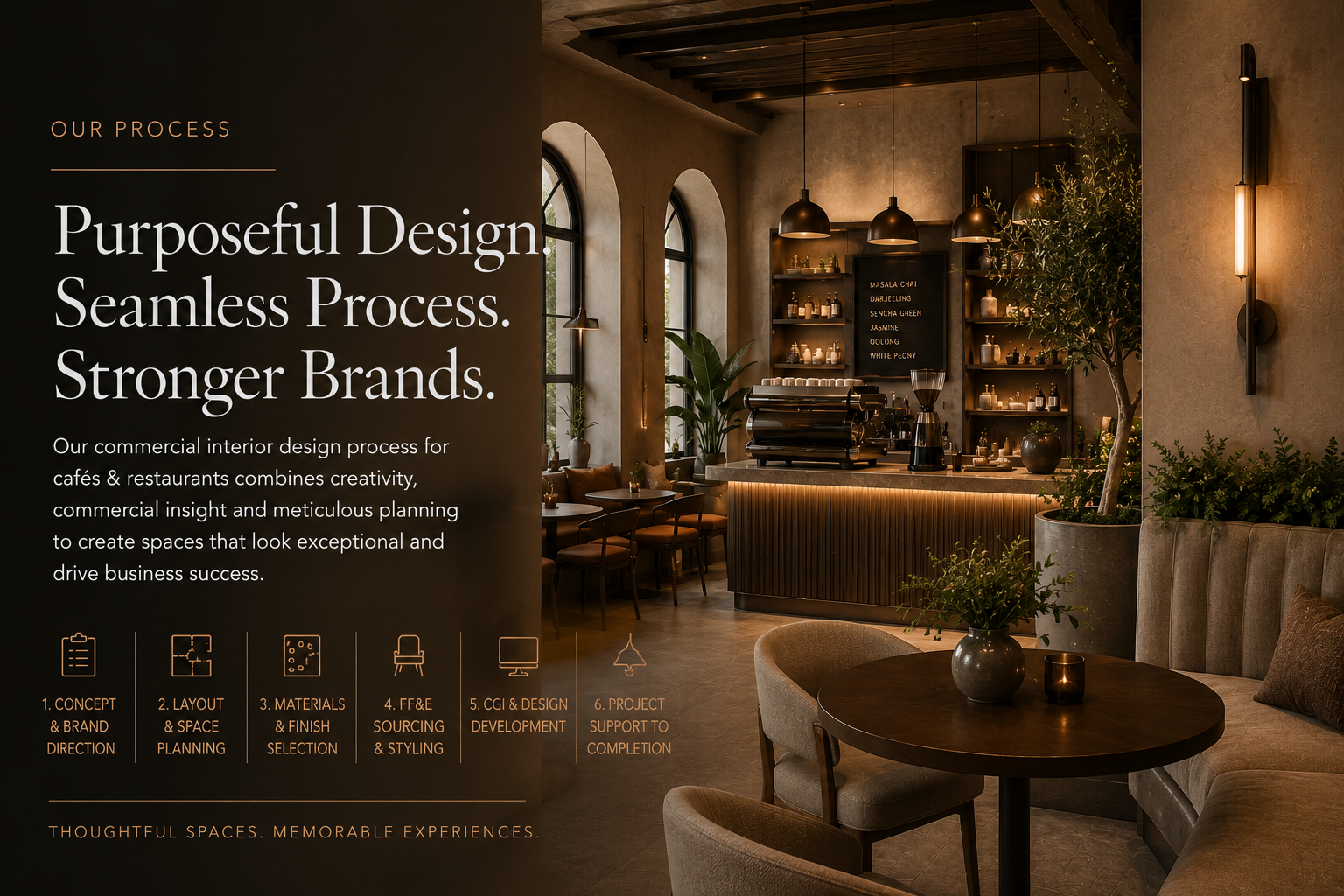
Our Commercial Interior Design Process
Every project is different, but our commercial interior design process usually follows a clear structure.
1. Initial Consultation and Project Understanding
We begin by understanding the business, the space, the goals, the customer base, the menu direction and the client’s overall vision.
This stage helps us understand what the design needs to achieve commercially and creatively.
2. Brand and Concept Direction
We then develop the creative direction of the space.
This includes the overall feel, atmosphere, customer experience, material palette, brand positioning and visual identity.
3. Layout and Space Planning
We look at how the space will function day to day.
This includes seating, counter positioning, customer flow, service routes and key visual moments.
4. Materials and Finish Direction
We explore flooring, wall finishes, lighting, textures, colour palettes and key materials that support the brand and customer experience.
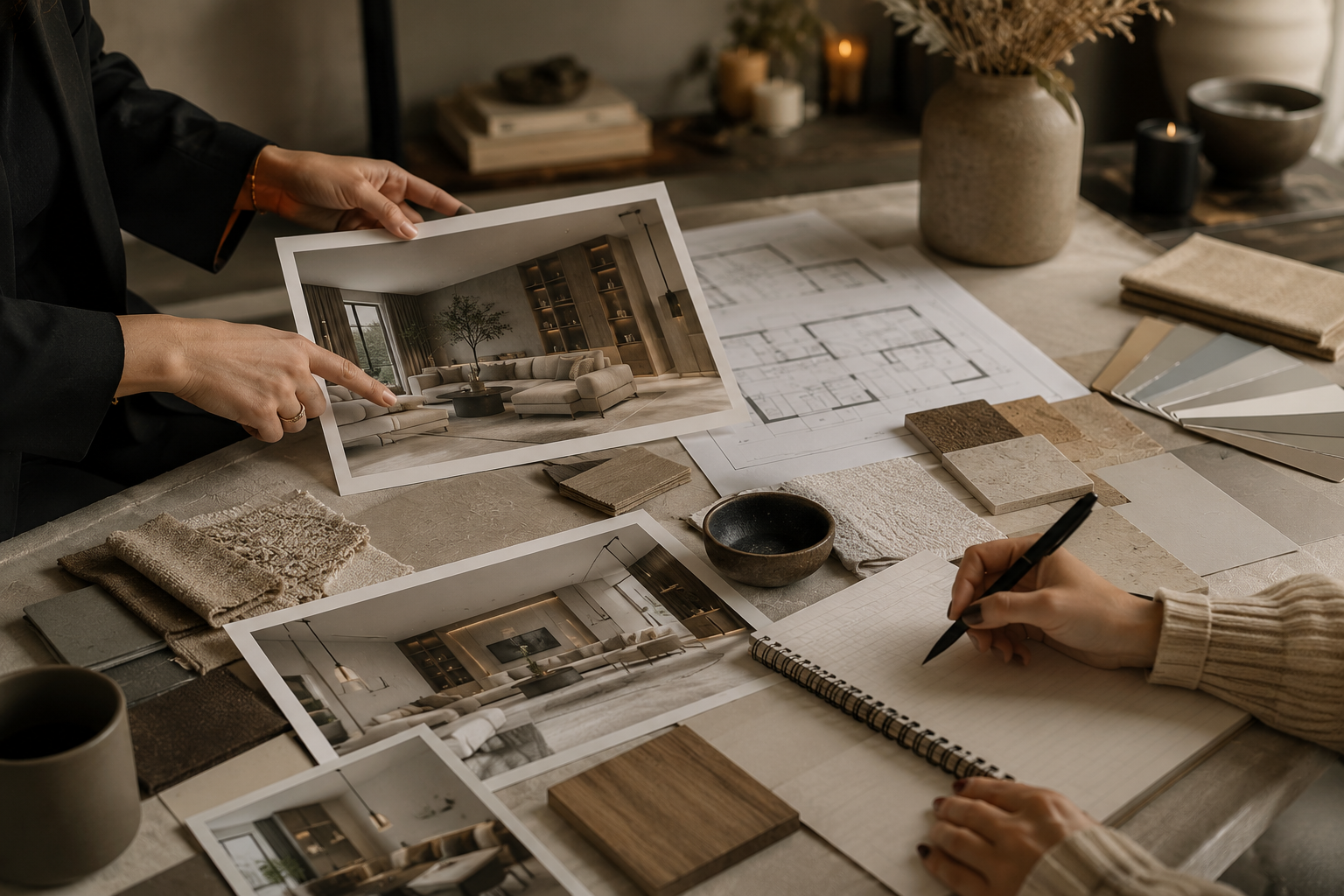
5. Mood Boards and Design Concepts
Mood boards help bring the ideas together visually, giving the client a clear sense of direction before more detailed decisions are made.
6. FF&E Direction and Sourcing
We identify furniture, fixtures, lighting, decorative elements and styling pieces that support the approved design direction and budget.
7. CGI Visuals and Refinement
Where required, CGI visuals or 3D renders help the client understand how the finished space could look and feel.
This is especially useful for investor approval, stakeholder discussions and final confidence before procurement.
8. Procurement Guidance and Specification
Once the design direction is approved, we can support sourcing, supplier coordination and specification recommendations.
9. Installation and Styling Support
Depending on the project scope, we can assist with installation coordination, styling and final presentation so the space opens with impact.
Why Working With an Interior Designer Early Helps
One of the biggest mistakes in commercial projects is bringing a designer in too late.
By that point, important decisions may already have been made around layout, lighting, finishes, counter positioning or furniture — and changing them can be expensive.
Working with an interior designer early helps avoid:
- Poor layout decisions
- Weak first impressions
- Disjointed branding
- Overspending in the wrong areas
- Underwhelming customer experience
- Missed visual opportunities
- Practical issues during fit-out
Early design input gives the project stronger direction from the beginning.
It also helps ensure money is spent where it will have the biggest impact.
Commercial Interior Design in Blackburn, Bolton, Lancashire and Beyond
As we continue to receive more enquiries for commercial interiors, cafés and restaurants are becoming an exciting area of growth for Genesis Interior Stylists.
Our approach combines:
- Interior design
- Brand direction
- FF&E sourcing
- Commercial planning
- Customer experience thinking
- Practical project awareness
Whether it is a café, tea house, restaurant, boutique hospitality venue or customer-facing commercial space, the goal is always the same:
To create an interior that looks beautiful, feels memorable and supports the success of the business.
Planning a Café or Restaurant Interior Design Project?
If you are opening a café, restaurant or hospitality space, the earlier you begin the design process, the better.
A strong interior design direction can help you create a space that feels distinctive, commercially considered and memorable from the moment customers walk in.
Genesis Interior Stylists works with commercial clients across Blackburn, Bolton, Lancashire and the wider North West, offering interior design, brand direction, FF&E sourcing and concept development for hospitality spaces.
If you are planning a café or restaurant project, we would love to help you bring it to life.
Contact Genesis Interior Stylists to discuss your commercial interior design project.